
By Charlotte Bennett, Child Development Specialist & Mother of Three (and therefore someone who has personally stepped on every toy listed below in bare feet)
Introduction: The Holy Grail of Five Minutes to Yourself
Let’s set the scene. It’s 9:47am. You’ve already drunk your coffee cold. The baby has somehow relocated your car keys into a pot plant. And you — brave, sleep-deprived soul — are standing in the middle of the living room wondering if it’s possible to shower, reply to two emails, and eat an actual piece of toast before the next meltdown.
Enter: the infant activity table.
Now, I know what you’re thinking. “Charlotte, isn’t that just a fancy plastic thing that makes noise?” Yes. Yes it is. And it is magnificent.
According to the UK’s leading paediatric experts, structured play activities are fundamental to healthy child development, supporting everything from fine motor skills to social interaction. But let’s be honest — while your baby is busy developing crucial neural pathways, you are busy developing the ability to drink tea at a temperature above lukewarm. Everyone wins.
Activity centers bridge the gap between your baby lying there staring at the ceiling like a tiny, confused philosopher, and them actually doing something with their hands. And they meet British Standard BS EN 14036:2003, which is the government’s way of saying “we checked — this won’t fall apart on your child.” The Office for Product Safety and Standards has your back.

Developmental Benefits: Or, Why This Isn’t Just a Very Expensive Noise Machine
Activity centers are, genuinely, developmental gold. Research from developmental psychology shows that structured play environments help children develop cognitive, motor, and social skills. They build cause-and-effect understanding (baby pushes button → music plays → baby is delighted → baby pushes button 400 more times → parent considers moving abroad).
The multi-sensory nature of these things — visual, auditory, tactile — stimulates the neural pathways that are absolutely critical during the early years. Basically, every time your baby bats at a spinning mirror or whacks a xylophone key, a little brain firework goes off. You are, in scientific terms, raising a genius.
Or at minimum, someone who will eventually stop eating your phone charger.
Safety First: Because Obviously
All ten products reviewed here comply with BS EN 14036:2003. But regardless of what a sticker says, you should always:
- Supervise your child during use (yes, all of us have “popped to the kitchen for thirty seconds” — we know)
- Follow the age and weight guidelines (they’re not suggestions)
- Check regularly for wear, wobbly bits, or anything that’s been chewed into an unrecognisable shape
- Limit sessions to 15–20 minutes at a time to avoid overstimulation — and, frankly, to maintain your own sanity
The Reviews: Ten Plastic (and Wooden) Saviours
1. Fisher-Price 2-in-1 Like a Boss Activity Center

“Like a Boss.” Honestly, Fisher-Price, well played. The baby sits there spinning a gear and pressing a button that makes a phone ring, looking like a middle manager who’s entirely too pleased with themselves. And they should be — this thing is brilliant.
It starts as a stationary entertainer for babies who can sit with support, then converts into a toddler play table when they’ve outgrown the seated stage. Sarah from Manchester, mother and certified toast-reheater, says: “The ability to transform from a seated entertainer to a standing play table meant we got years of use. The music and lights kept Emma engaged for 20–30 minutes at a time, giving me precious moments to prepare meals or handle household tasks.”
Twenty to thirty minutes, people. That’s basically a spa day by parent standards.
Key Features:
- Transforms from baby entertainer to toddler play table (the metamorphosis you didn’t know you needed)
- 360-degree rotating seat with height adjustment
- Interactive toys with lights, sounds, and music
- Removable toy bar for easy cleaning
- Foldable design for storage
Specs: Ages 6 months to 3 years | Weight limit: 11.3 kg | 71 x 71 x 69 cm | 3 AA batteries | BPA-free plastic | BS EN 14036:2003 compliant
2. Baby Einstein Curiosity Activity Station

Named after history’s most famous physicist and designed for children who are already showing early signs of wanting to take everything apart and see what’s inside, this is the STEM table for babies who were born curious.
It features spinning gears, removable circuits, and sixty-five — SIXTY-FIVE — melodies and sounds. It also speaks three languages, which means your toddler may soon be trilingual before you’ve got round to learning conversational French on that app you downloaded eighteen months ago.
Dr. James Peterson, a paediatric occupational therapist from Edinburgh, notes: “I’ve observed significant improvements in fine motor skills and cause-and-effect understanding in children who regularly use this table.” The legs are also removable, so it starts as a floor toy and grows into a standing table. Developmental and economical. Très bien.
Key Features:
- Montessori-inspired design (fancy way of saying “encourages them to figure it out themselves”)
- Two-sided art and science activities
- 65+ melodies and sounds
- Removable legs for floor or standing play
- Volume control — praise be
Specs: Ages 12 months to 3 years | 70 x 61 x 44 cm | Weight: 4.21 kg | 3 AA batteries | English, Spanish, French
3. Bright Starts Around We Go 2-in-1 Walk-Around Activity Centre

The name sounds like a polite British phrase for going in circles at a roundabout, and honestly, that’s not far off — your baby will be going around this thing all day long, discovering a new toy every time they rotate, like a very small tourist at a very plastic theme park.
Lisa from Birmingham, mother of twin boys (a woman who deserves an actual medal), reports: “My twin boys loved the 360-degree rotation feature. The drum set was a particular hit. When they outgrew the walker function, removing the seat created a perfect standing activity table that lasted until they were nearly three.”
There’s a light-up drum set. A light-up drum set. Your neighbours are going to love you.
Key Features:
- 360-degree swivel seat for total toy access
- Light-up drum set (you have been warned)
- 10 engaging activity toys
- Removable seat for conversion to play table
- Non-slip base for safety
Specs: Ages 6 months to 3 years | Weight limit: 11.3 kg | 76 x 76 x 66 cm | 2 AA batteries | Non-slip base, rounded edges
4. VTech Touch & Learn Activity Desk

If your child’s first word is “phonics” rather than “mama,” you’ll know exactly which product to thank. The VTech Touch & Learn is less “baby toy” and more “tiny office for a very ambitious toddler.” It transforms from a desk into an easel, comes with its own stool, and teaches letters, numbers, shapes, and colours.
Rachel from Leeds, early years teacher and mother, says: “The touch-sensitive surface responds to my daughter’s interactions, teaching letters, numbers, and shapes. The transformation from desk to easel adds artistic development, and the included stool makes it feel like a real workspace.”
A real workspace. Your two-year-old has a more organised desk than you do. Congratulations.
Key Features:
- Touch-sensitive learning surface
- Transforms from desk to easel (multitasking: not just for parents)
- Interactive learning pages
- Includes a stool
- LED display for visual feedback
Specs: Ages 2 to 5 years | 58 x 41 x 45 cm | 4 AA batteries | Covers letters, numbers, shapes, colours
5. Bright Starts Bounce Bounce Baby Activity Jumper

There are two types of babies: those who sit contentedly observing the world, and those who want to bounce. If yours is the latter — the one who has been trying to launch themselves off your knee since month three — this is the product for them.
Physical therapist Mark from Cardiff recommends it with one important caveat: “I recommend limiting sessions to 15–20 minutes to prevent overstimulation.” Which is wise advice, because if you’ve ever seen a baby on a spring in the late afternoon having bounced for 45 minutes straight, you will understand the phrase “overtired chaos gremlin.”
The 360-degree rotating seat means they can access all twelve removable toys from their springy throne. It’s also doorway-free, which is excellent news if you’ve ever tried to mount something in a rental property.
Key Features:
- Safe spring-loaded bouncing action
- 360-degree rotating seat
- 12 removable toys and activities
- 3-position height adjustment
- Machine-washable seat pad (very important feature, this)
- Doorway-free design
Specs: Ages 6 to 12 months | Weight limit: 11.3 kg | 89 x 89 x 97 cm | Steel frame, fabric seat | Meets all UK safety standards
6. Janod Multi-Play Activity Center
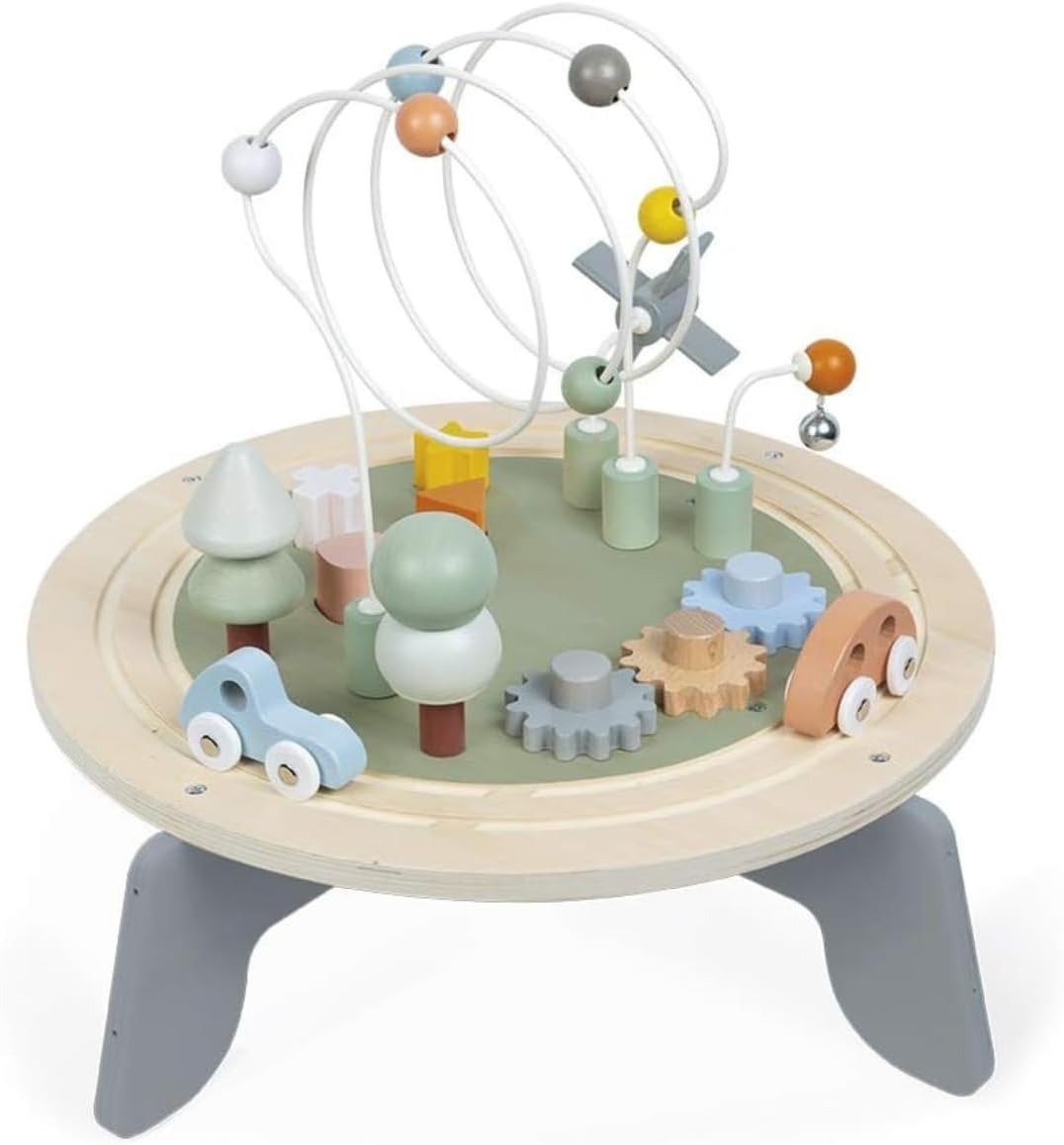
Ah. The Janod. The one you show your mother-in-law to prove you’re doing this parenting thing with taste.
This French-designed wooden beauty is the activity center for parents who have already banned plastic from the living room and own at least one piece of linen clothing. It features a xylophone, shape sorter, stacking elements, and is made from FSC-certified wood with non-toxic, water-based paints.
Claire from Oxford, interior designer and mother, puts it eloquently: “The wooden construction fits beautifully in our living space while providing hours of engagement. The quality craftsmanship means it will certainly be passed down to future children.”
Yes. This is a heirloom-grade baby toy. Your grandchildren may one day argue over it.
Key Features:
- Sustainable FSC-certified wood construction
- Multi-sensory activities including a xylophone
- Shape sorting and stacking elements
- Non-toxic, water-based paints
- Rounded edges for safety
- Compact enough for smaller spaces
Specs: Ages 18 months to 4 years | 35 x 35 x 47 cm | Weight: 3.2 kg | Designed in France (naturellement)
7. Baby Einstein Activity Table Walker
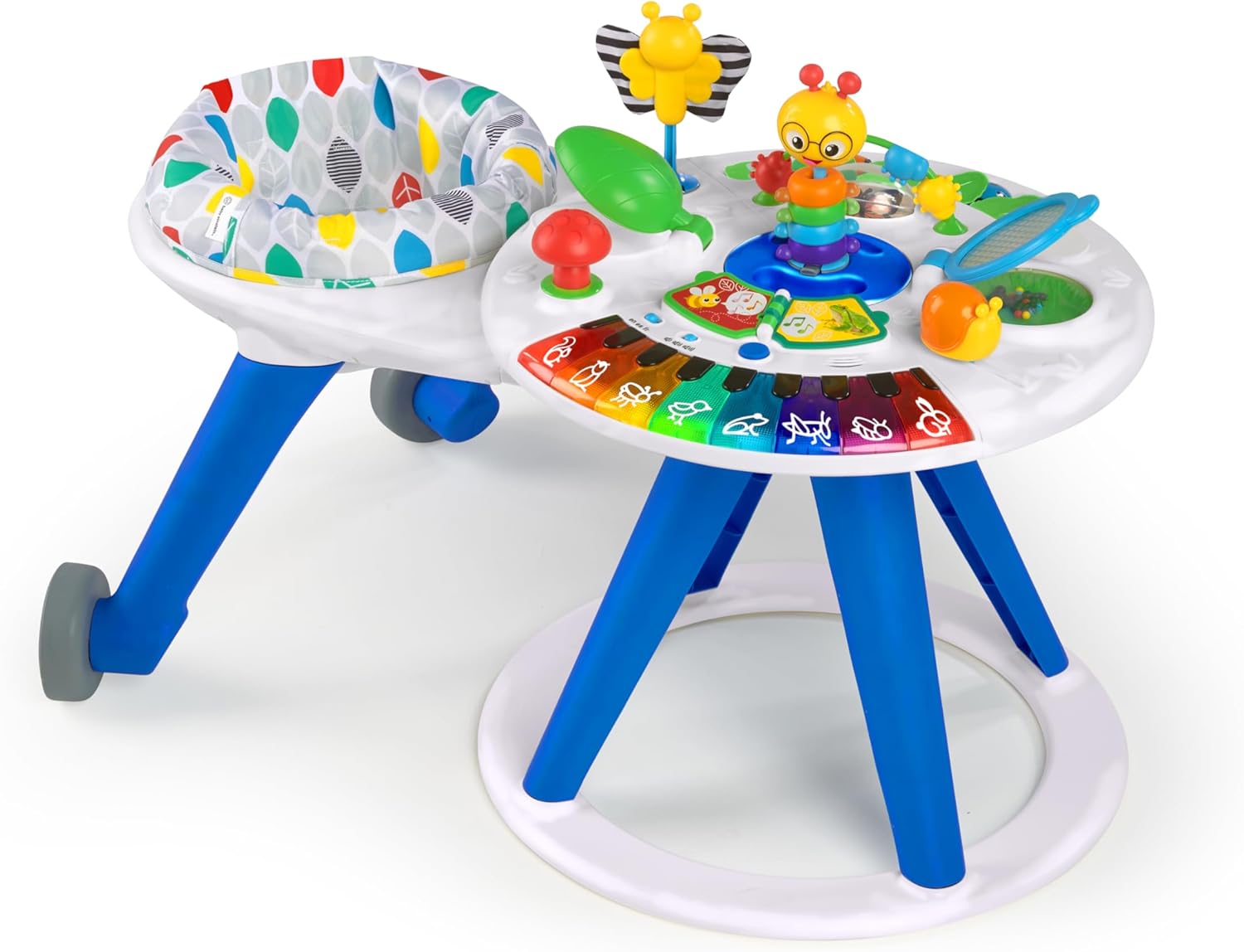
Baby Einstein is to baby toys what a good GP is to medicine: reliable, respected, and always there when you need them. This 4-in-1 walker features classical music, nature sounds, light-up piano keys, and a large play surface that can be used at multiple stages of development.
Patricia, nursery manager from Glasgow, reports: “We’ve used these in our nursery for three years with excellent results. The combination of classical music with colourful lights creates a calming yet stimulating environment.”
Calming. Calming. It has classical music. Your baby is essentially at a concert. Mozart would be pleased.
Key Features:
- Classical music and nature sounds
- Light-up piano keys (tiny maestro incoming)
- Removable toy station
- Easy-fold design for storage
- 3-position height adjustment
- Large play surface
Specs: Ages 6 months to walking | Weight limit: 11.3 kg | 70 x 65 x 61 cm | 2 AA batteries | BPA-free plastic
8. Battat Wooden Activity Center
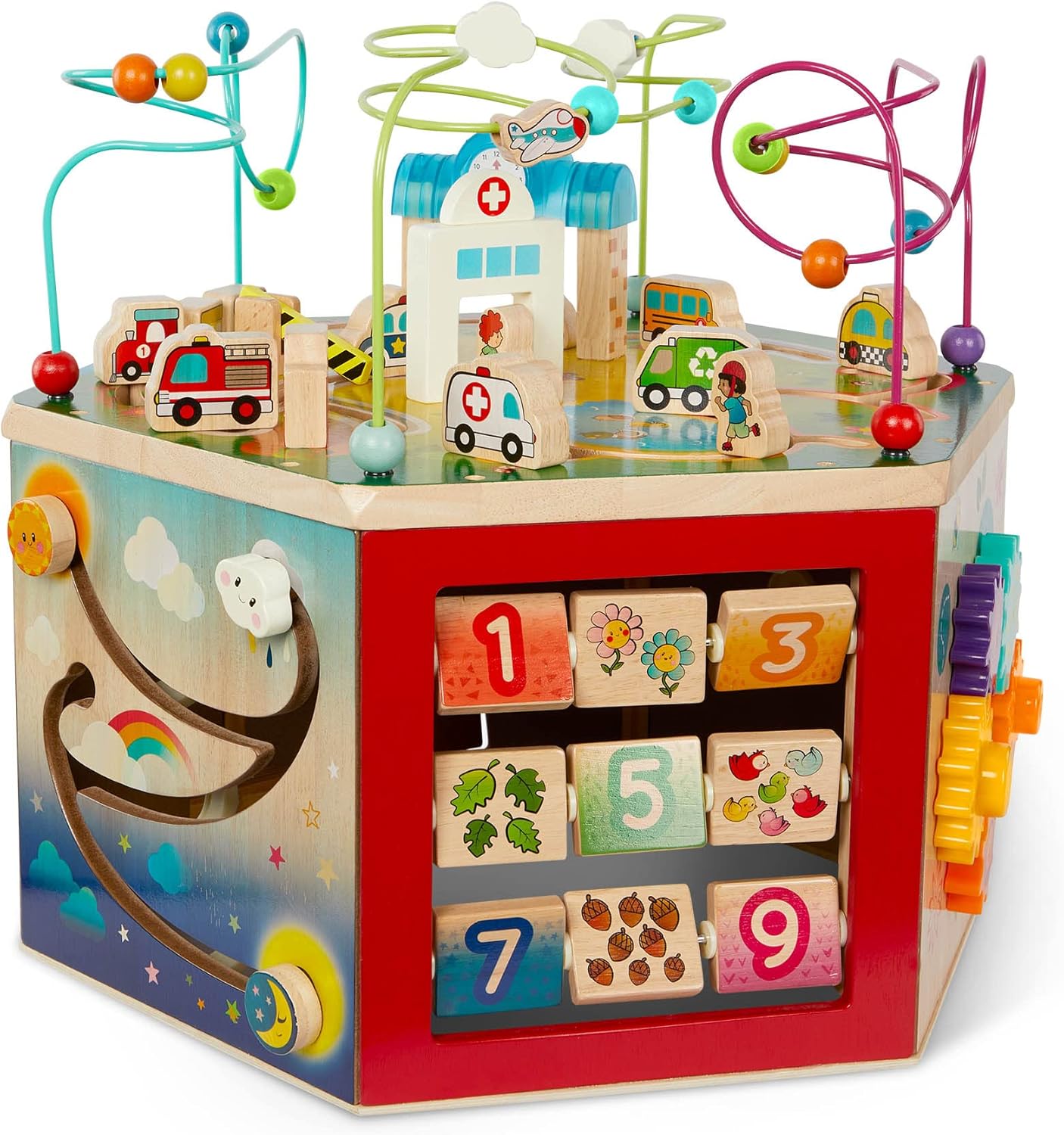
No batteries. No blinking lights. No sound effects. No problem.
The Battat Wooden Activity Center is the introverted, screen-free cousin of all the electronic options above — and it is absolutely glorious. Natural hardwood construction, wire bead mazes, shape sorting, and stacking elements. It runs entirely on imagination. And toddlers. Toddlers love it.
David, an early childhood educator from Newcastle, observes: “Children spend longer periods engaged with this center compared to electronic alternatives. The wire maze and bead activities are particularly effective for developing concentration and fine motor skills.” Concentration! In a toddler! The man is basically reporting a miracle.
Key Features:
- 100% natural wood construction
- Wire bead maze for fine motor development
- Shape sorting and stacking elements
- Zero batteries required (revolutionary)
- Non-toxic, child-safe stains
- Sustainable materials
Specs: Ages 12 months to 4 years | 38 x 38 x 51 cm | Weight: 4.1 kg | Natural hardwood | Minimal assembly required
9. Manhattan Toy Adventure Activity Centre
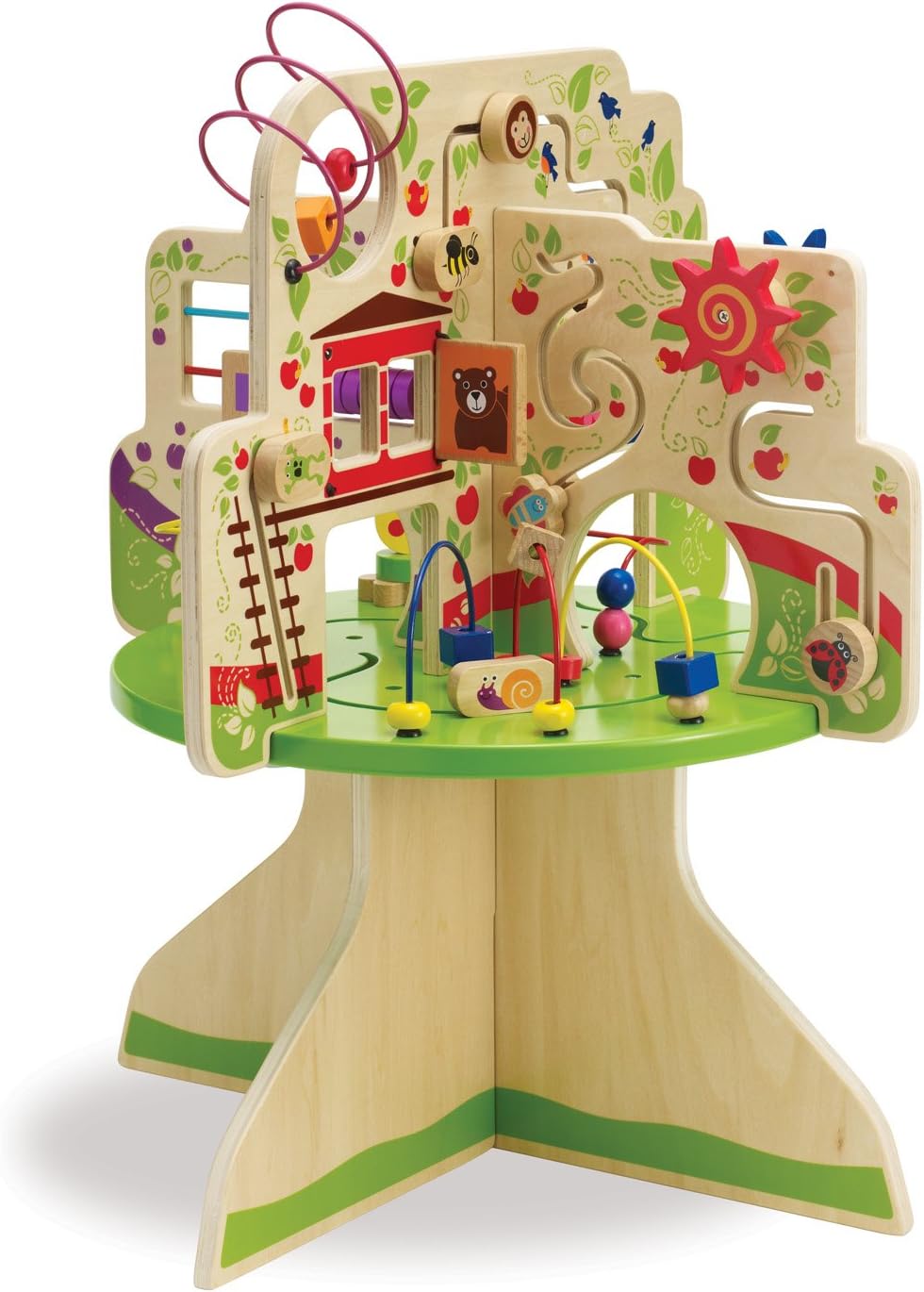
When the Manhattan Toy designers sat down to create this activity centre, we imagine they asked themselves: “What if a baby toy was also genuinely interesting?” The result is an open-ended, texture-rich, unconventional activity centre that child psychologist Dr. Emma Wilson from Bristol is quite enthusiastic about.
“I’ve observed children return to this center repeatedly, discovering new ways to interact with the elements,” she says. “The varied textures and unconventional activities encourage exploration and problem-solving.”
In other words: it keeps them coming back. Like a very safe, developmentally appropriate video game. Except made of fabric, wood, and plastic. And it doesn’t require Wi-Fi.
Key Features:
- Unique activity design that rewards repeated exploration
- Multiple textures and mixed materials
- Open-ended play opportunities (no wrong answers)
- Durable construction
- Compact footprint
Specs: Ages 6 months to 3 years | 32 x 32 x 43 cm | Weight: 2.8 kg | Wood, fabric, and plastic | Designed in New York
10. Oathx Activity Montessori Sensory
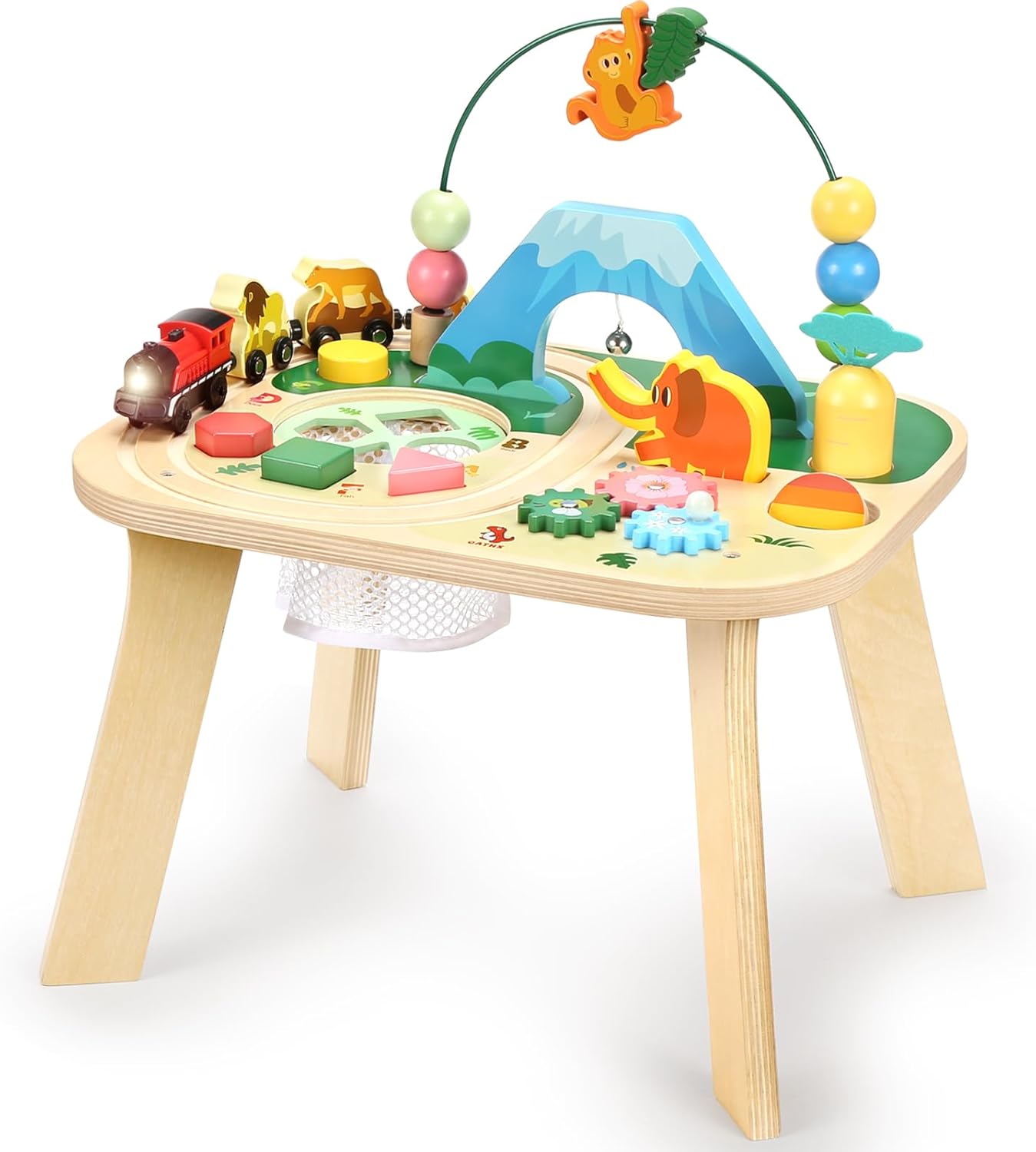
The Oathx is the one for babies who experience the world a little differently — and occupational therapist Sarah Mitchell from Liverpool is its most enthusiastic advocate.
“The Montessori approach combined with sensory elements makes this ideal for children with diverse needs,” she explains. “The various textures, sounds, and manipulative activities support sensory integration and self-regulation.”
It’s thoughtfully designed, portable, easy to clean (essential), and built around the idea that play should be appropriately challenging — not frustrating, not boring. It’s also a genuinely lovely first birthday gift, if you’re looking for something that isn’t another stuffed animal your hallway cupboard cannot accommodate.
Key Features:
- Montessori-based activity design
- Comprehensive sensory elements across multiple difficulty levels
- Supports sensory integration and self-regulation
- Portable design (takes up very little space)
- Easy to clean (we cannot stress this enough)
Specs: Ages 6 months to 3 years | 30 x 30 x 35 cm | Weight: 1.9 kg | Natural and synthetic elements | Suitable for occupational therapy settings
Safety: The Slightly Less Fun But Extremely Important Section
All activity centers reviewed here comply with British Standard BS EN 14036:2003, which covers structural integrity, stability, and safety features. Because we want your child to have fun, not give you a cardiac event.
The Royal Society for the Prevention of Accidents also provides helpful guidance on choosing and using children’s products safely. Their recommendations align neatly with common sense:
- Always supervise children during use
- Follow manufacturer weight and age guidelines (the sticker is not a dare)
- Inspect regularly for wear, loose parts, or anything that’s been used as a chew toy
- Ensure proper assembly — “mostly assembled” is not assembled
- Limit use to 15–20 minutes per session to prevent overstimulation
Frequently Asked Questions: The Ones We Know You’re Googling at 2am
At what age can my baby start using an activity center? Most are suitable from around 6 months, when babies can sit with support. Some, like the VTech Touch & Learn, are better suited to toddlers of 2+. Always check the label and trust your instincts about whether your child is ready — you know them best.
How long should my baby use an activity center each day? Paediatric occupational therapists recommend 15–20 minutes at a time, with no more than two hours total per day. Balance it with tummy time, free play, and just… looking at things. Babies are surprisingly good at that.
Are activity centers safe for development? When used appropriately, absolutely. They support reaching, grasping, cause-and-effect learning, and sensory development. The Royal College of Paediatrics and Child Health emphasises that varied play experiences are key — activity centers are a great tool, not the whole toolkit.
What’s the difference between an activity center and a baby walker? An activity center is stationary — your baby stays put while the toys come to them. Traditional walkers move around, which creates mobility-related safety risks. Many modern products combine both functions, but if you’re choosing between the two, stationary centers are generally considered the safer bet.
How do I clean and maintain one? Fabric components are usually machine washable. Plastic parts get a wipe down with mild soap and water. Wooden elements need a wood-safe cleaner — don’t use anything that would strip a dining table. And do regular checks for anything loose, cracked, or suspiciously tooth-shaped.
Which is best for small spaces? The Janod Multi-Play Activity Center and the Manhattan Toy Adventure Activity Centre are both compact enough to coexist with actual furniture. Many others fold for storage — including the Fisher-Price and Bright Starts options — which is useful when you need the floor back for, you know, existing.
Conclusion: So Which One Should You Actually Buy?
The honest answer is: the one that fits your child’s age, your space, your budget, and your tolerance for battery-operated music.
If you want maximum longevity and versatility, the Fisher-Price 2-in-1 Like a Boss Activity Center will genuinely grow with your child from six months to toddlerhood — that’s a lot of toast you’ll get to eat warm.
If STEM is your thing, the Baby Einstein Curiosity Activity Station with its 65 melodies and trilingual ambitions is the one for your future scientist.
If you’ve got an active bouncer on your hands, the Bright Starts Bounce Bounce Baby Activity Jumper will channel that energy beautifully (and give your knees a rest).
If you’re choosing aesthetics alongside function, the Janod Multi-Play Activity Center and the Battat Wooden Activity Center are your people.
For the curious, texture-seeking, sensory-led little ones, don’t overlook the Oathx Montessori Sensory Table, the Manhattan Toy Adventure Activity Centre, or the Baby Einstein Activity Table Walker for reliable educational fun.
And if you want your toddler to be literate before they’re three, well — the VTech Touch & Learn Activity Desk is right there.
Whatever you choose, remember: activity centers are a wonderful tool, but they’re not a substitute for you. Your child still thinks you’re the best toy in the house. Statistically, you’re also probably louder than the drum set.
For more guidance on child development, the Royal College of Paediatrics and Child Health has excellent resources — written by people with considerably more sleep than most of us.
Now go. Make a hot drink. You’ve earned it.

Charlotte Bennett is a highly experienced Child Development Specialist and devoted mother of three, based in the UK. With over 12 years of professional experience and a strong academic background, Charlotte holds a BA (Hons) in Early Childhood Studies and is a Level 3 Qualified Childcare Practitioner, accredited through CACHE. She is also certified in Safeguarding Children (Level 3) and Paediatric First Aid.
Charlotte combines her professional expertise with personal insight as a parent, offering a practical, compassionate approach to supporting children’s emotional, social, and cognitive development. She has worked extensively across early years settings, primary education, and family support services, specialising in early intervention, positive behaviour strategies, speech and language support, and parent coaching.
Her dual perspective—as both a qualified practitioner and hands-on parent—enables her to provide evidence-based guidance that is both relatable and effective. She frequently collaborates with GPs, health visitors, educators, and local authorities to ensure coordinated, child-centred care.
Charlotte is passionate about helping families build confidence and create nurturing environments. Her work is rooted in current research and best practice, with a strong focus on safeguarding, developmental milestones, and emotional wellbeing.
Disclosure: This article contains affiliate links to products I personally use and recommend. When you purchase through these links, I may earn a small commission at no additional cost to you. All recommendations are based on my genuine experience and testing—I only recommend products I actually use in my own home.