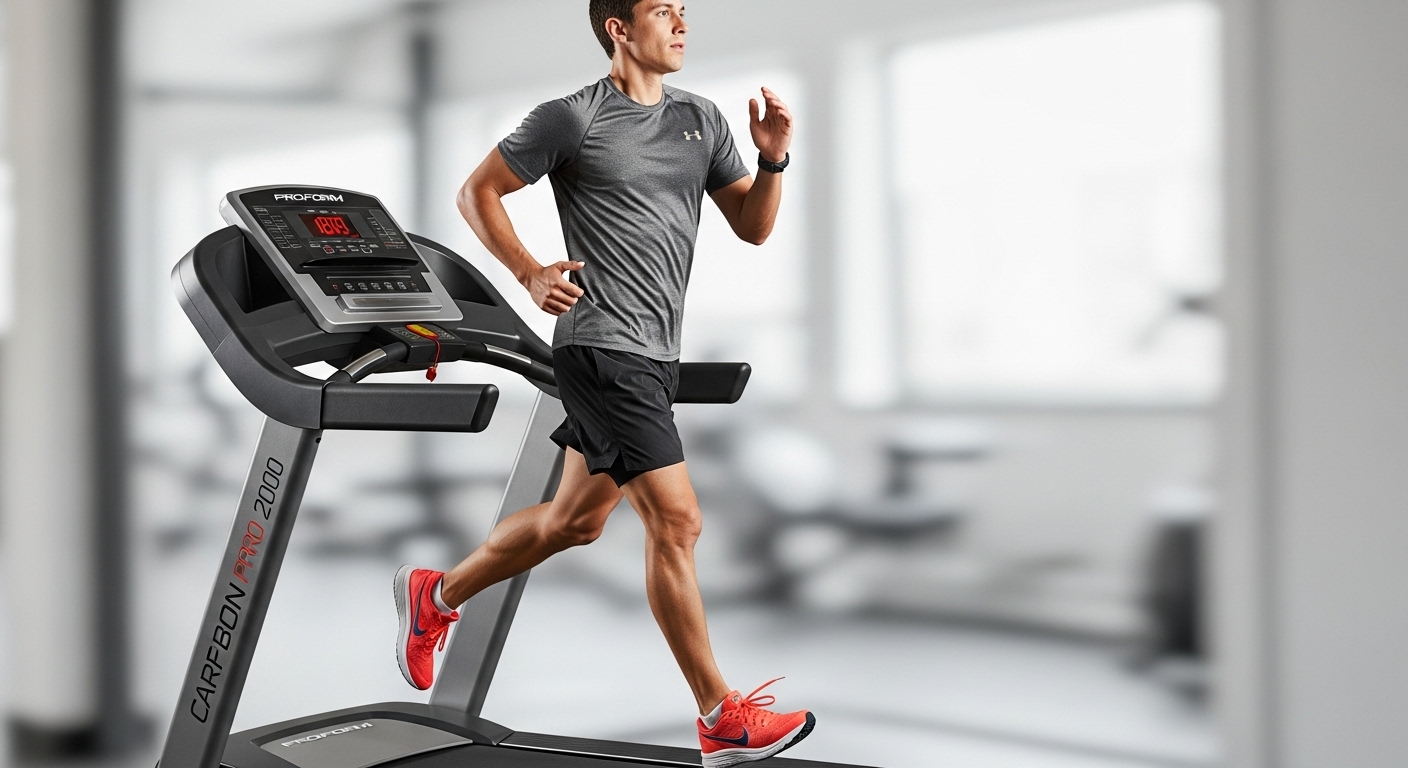
Let me paint you a picture. It’s 6:47am. You’re standing in your living room, staring at a £1,200 piece of machinery that is both your greatest investment and your most expensive coat hanger. You’ve made promises to yourself. This time is different. This time, you actually paid for the thing.
Welcome to the ProForm Carbon Pro 2000 review — where we find out if this treadmill is genuinely worth its price tag, or whether you’d have been better off investing that money in a very long pavement and a decent pair of trainers.
Build Quality and Design Philosophy
(Or: “Is This Thing Going to Collapse When I Finally Commit to Running?”)
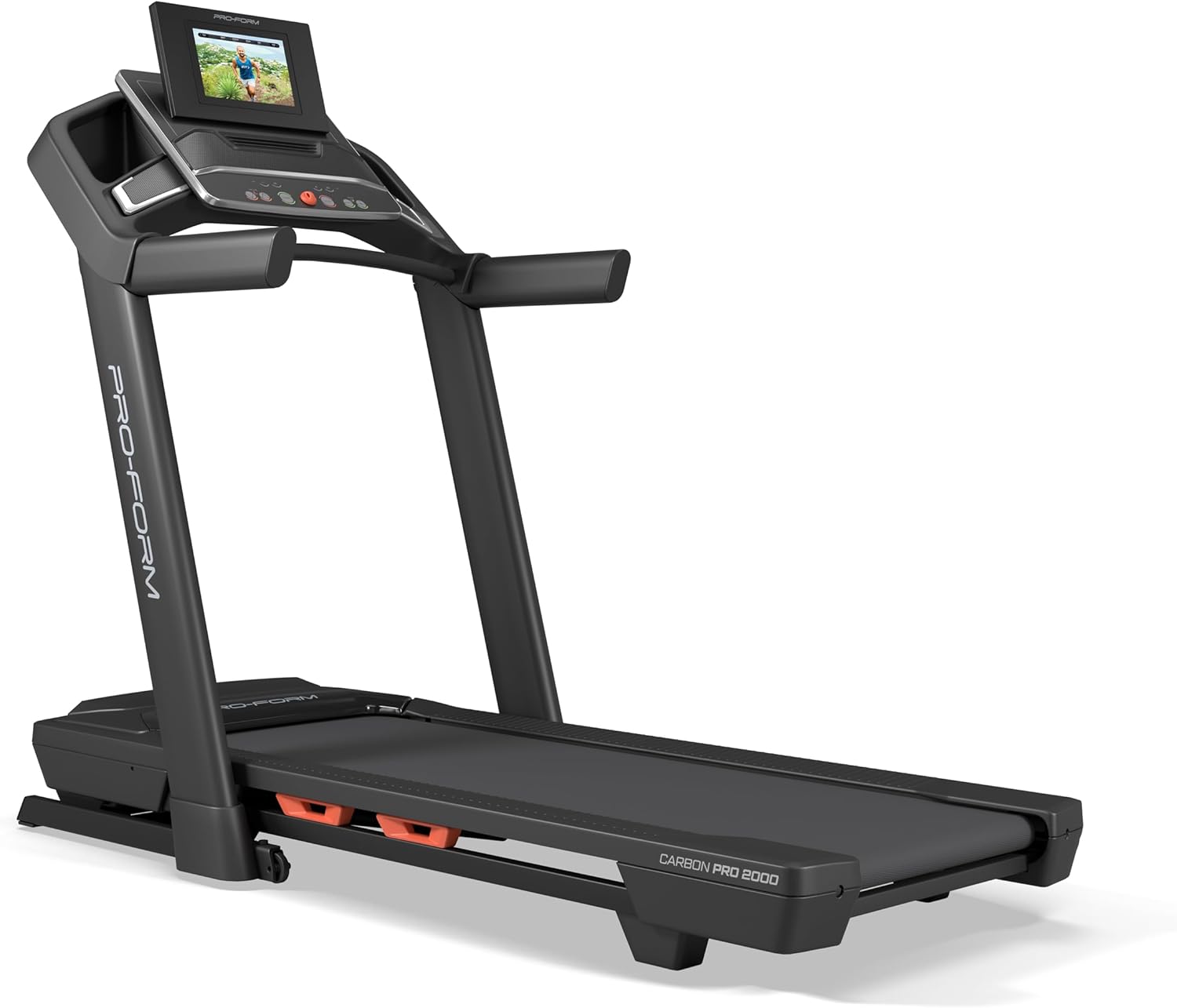
The ProForm Carbon Pro 2000 walks into the room like it owns the place. Welded steel frame, serious structural integrity, the kind of build quality that quietly judges your posture. It fits right in with any modern home gym setup built around serious leg training — though it’ll probably show up those dusty dumbbells in the corner.
Footprint-wise, you’re looking at 83 inches by 39 inches. For those of you not fluent in imperial measurements (fair enough, we’re British), that’s roughly the size of a mid-range optimism. Fortunately, the SpaceSaver design with EasyLift Assist lets you fold the deck vertically, which is either brilliant engineering or confirmation that the product designers also know you’ll spend three weeks avoiding it.
Weight capacity hits 350 pounds, which means it can handle virtually all users without complaint — a generosity this treadmill extends more freely than most gym partners.
Motor Performance and Reliability
(The Part Where Engineers Justify the Price Tag)
Tucked inside this beast is a 4.0 CHP Mach Z commercial-grade motor, which sounds like a villain from a mediocre superhero film but is, in fact, the reason this treadmill doesn’t sound like a blender full of gravel.
Speed range runs from a dignified stroll all the way to 12 mph, which is either a brisk run or the exact speed at which you flee when you spot someone from work at the supermarket. The motor handles acceleration and deceleration smoothly — no jarring lurches that send you shooting off the back like a clumsy game show contestant.
Noise levels are impressively low. You can run in the early hours without waking the household, which means your fitness guilt no longer has to be everyone’s problem. It can remain privately, quietly yours.
Running Surface and Cushioning Technology
(Your Knees Called. They Said Thank You.)
The running surface measures 22 inches wide by 60 inches long — roomy enough for natural stride patterns and comfortable for users up to 6’6″. If you’re taller than that, congratulations on your remarkable height, and perhaps consider a longer model.
ProForm’s ProShox cushioning system is the genuine star of this section. It reduces joint impact by up to 28% compared to road running, which means it’s essentially kinder to your body than actual pavements. The cushioning responds dynamically to your foot strike — firm during push-off, absorptive on landing. Like a very attentive butler, but for your ankles.
Belt quality is excellent for this category — multi-ply construction, solid grip, consistent tracking. It’s the kind of belt that simply gets on with the job and doesn’t require constant fussing. We respect that in a belt.
Console Technology and User Interface
(Because Apparently Running Also Needs a Smartphone Now)
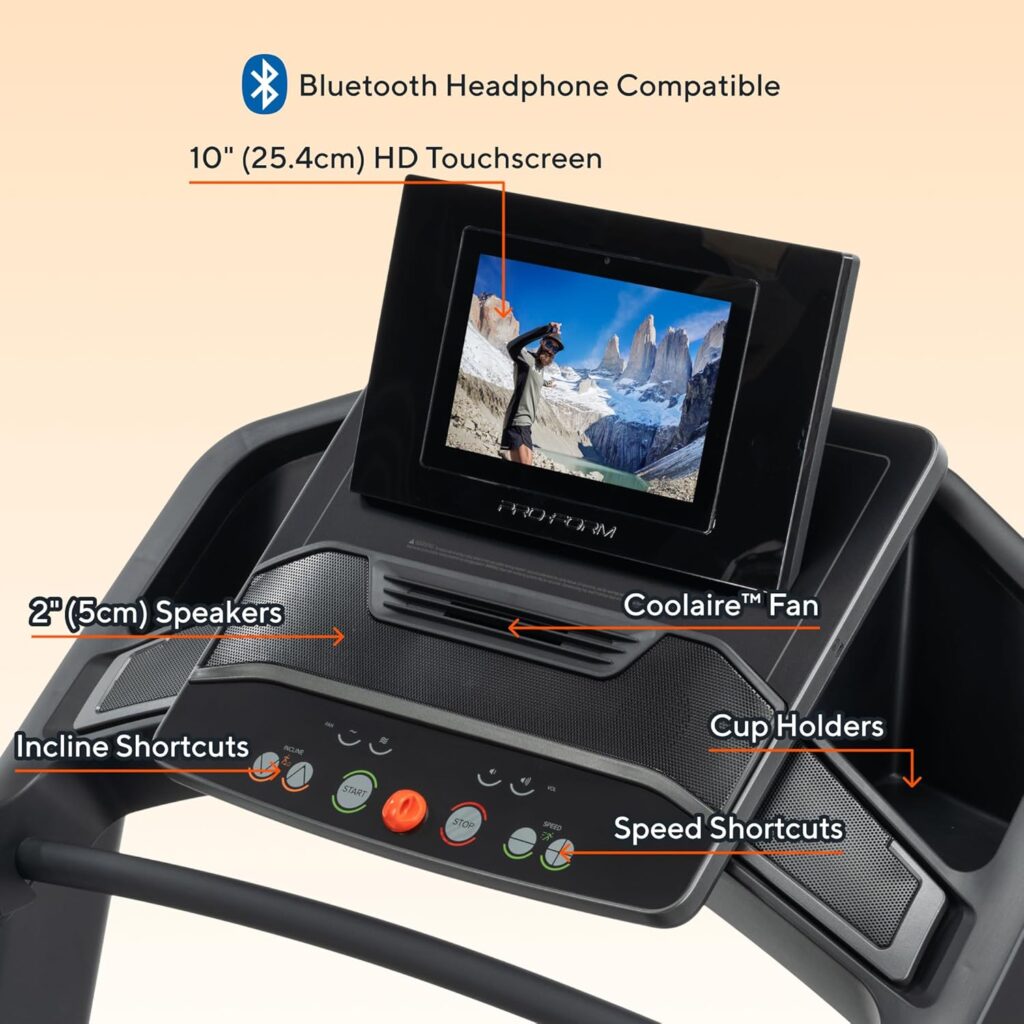
The 10-inch Smart HD touchscreen is sharp, responsive, and infinitely more attractive than the blank wall most of us previously stared at on the treadmill. Controls are logical, screen positioning works across varying heights, and the display shows you everything: speed, incline, distance, time, calories, heart rate — basically a live broadcast of your slow deterioration, rendered crisply in high definition.
Integration with fitness apps like iFit, Zwift and other training platforms turns this from a standalone machine into a full fitness ecosystem. Whether that excites you or makes you feel slightly hunted by your own exercise equipment is a matter of personal temperament.
Incline Capabilities and Performance
(Going Uphill Without Leaving the House — Peak Modern Life)
This is where the ProForm Carbon Pro 2000 becomes genuinely impressive. It offers incline range from -3% decline to a 15% gradient, giving you everything from gentle downhill recovery runs to climbs that will make you sincerely reconsider your relationship with hills.
The OneTouch incline controls let you adjust mid-workout without breaking stride — crucial for interval training, or for those moments when you’re absolutely certain 12% incline was a terrible idea and need to quietly dial it back before anyone notices.
The decline function is a genuine differentiator here. Many competing models don’t offer it, and it opens up muscle engagement patterns that flat running simply can’t replicate. Variety, as they say, is the spice of fitness.
Workout Programs and Training Options
(Fifty Shades of Cardio)
Fifty built-in workout programs. Fifty. That’s enough variety to keep you occupied for months before you start repeating yourself, and iFit compatibility adds thousands more — led by actual professional trainers who are almost certainly more enthusiastic about this than you currently feel.
Programs span the full spectrum: beginner walking routines for those of us who’ve had a difficult winter, through to advanced interval protocols for people who use words like “lactate threshold” in casual conversation. Heart-rate based workouts, hill simulations, speed intervals — it’s all there, waiting patiently while you decide whether today is, in fact, a rest day.
The subscription service is optional, though it significantly extends long-term engagement. Consider it Netflix for your legs.
Heart Rate Monitoring and Fitness Tracking
(Your Body Has Data. The ProForm Wants It.)
Heart rate monitoring comes via both built-in contact sensors on the handlebars and wireless chest strap compatibility. The contact sensors are perfectly adequate for moderate sessions. For high-intensity work, the wireless option delivers better accuracy — though wearing a chest strap does make you feel approximately 40% more serious about the whole enterprise.
Heart rate-based programmes automatically adjust speed and incline to keep you in target zones, which is genuinely useful if you prefer your workouts to do the thinking. Data syncs across popular fitness platforms, supporting the long-term obsession with tracking numbers that modern wellness culture requires of us.
Assembly and Initial Setup
(Abandon All Hope, Ye Who Enter Alone)
Let’s not sugarcoat this: assembly takes 3-4 hours with two people. Solo attempts are technically possible, in the same way that assembling flat-pack furniture alone is technically possible — with a similar emotional journey.
Instructions are clear. Some steps involve components that are genuinely heavy. Professional assembly services exist, and they are not a sign of weakness. They are a sign of wisdom and a healthy respect for your lumbar region.
Initial setup includes software updates, account creation, and calibration. It’s time-consuming upfront, but you only do it once, and afterwards the machine is properly tuned and ready to gently shame you into actually using it.
Maintenance Requirements and Longevity
(Low Drama, Long Life)
Routine maintenance is mercifully minimal. Periodic belt lubrication, regular surface cleaning, occasional inspections — nothing that demands specialist knowledge or a troubling amount of your weekend. The manufacturer provides clear schedules and procedures, and all the key components are accessible without disassembly.
Expected residential lifespan sits at 10-15 years with proper care. That’s a significant run (no pun intended), and it means the cost-per-use calculation improves considerably if you actually commit to using the thing. Which, obviously, you absolutely will. This time.
Comparative Analysis and Market Position
(The Part Where We Tell You What Else You Could Have Bought)
In the mid-range treadmill arena, the ProForm Carbon Pro 2000 goes up against NordicTrack, Sole Fitness, and Horizon. On motor specifications alone, it beats most alternatives at this price point. Cushioning technology rivals models costing considerably more.
It’s the kind of treadmill that makes higher-end competitors slightly nervous, because it delivers genuinely commercial-grade features without the commercial-grade invoice. Feature density is exceptional — this is a machine that earns its price tag rather than simply claiming it.
Experienced runners get what they came for: serious motor power, precision controls, and a robust build that handles aggressive training without flinching. This machine doesn’t buckle under interval work. It simply waits for you to catch your breath and then invites you to go again.
Rehabilitation users benefit from the gentle speed ranges and decline capabilities, supporting varied therapeutic protocols — though obviously, in those cases, professional guidance applies.
Technology Integration and Future-Proofing
(Your Treadmill Is Smarter Than Your Television)
Smart device connectivity supports current and emerging fitness technologies, with regular software updates that expand functionality over time. This is a meaningful distinction from purely hardware-focused competitors — the ProForm Carbon Pro 2000 improves after purchase, which is more than can be said for most expensive decisions.
App ecosystem integration provides community features and evolving training methodologies that serve the long-term motivation challenge. It’s easy to buy expensive home gym equipment like a solid squat rack setup and then gradually stop using it. This machine actively fights that tendency.
Forward compatibility looks solid — this treadmill will remain relevant as the fitness technology landscape evolves, protecting your investment across extended ownership.
Wrapping It Up
(The Bit You Skipped to If You’re Honest)
The ProForm Carbon Pro 2000 is genuinely excellent. Not “excellent for the price” — just excellent, full stop. Motor performance, build quality, cushioning technology, incline range, and smart integration all combine into a package that would be remarkable at a higher price and is frankly a bit outrageous at this one.
Is it right for everyone? Budget-focused buyers can find functional alternatives at lower price points, and nobody is judging you for that. But those alternatives will make meaningful compromises on motor power and build longevity that become apparent over time and intensive use.
For intermediate to advanced users who are serious about building a capable home training space — this treadmill belongs in the conversation. It’s powerful, precise, well-built, and smart enough to hold your hand through the sessions when motivation is thin on the ground.
Jodie Carter is a REPS Level 3 certified personal trainer with over 8 years of experience in strength training and home gym design. She holds qualifications in exercise physiology and has helped over 500 clients design effective home workout spaces. Jodie regularly contributes to UK fitness publications and maintains continuing education in the latest exercise science research.
Disclosure: This article contains affiliate links to products I personally use and recommend. When you purchase through these links, I may earn a small commission at no additional cost to you. All recommendations are based on my genuine experience and testing—I only recommend products I actually use in my own home.
Let’s be honest with each other. You’re not going to the gym. You said you would. You even googled “gyms near me” once at 11pm in a moment of wild optimism, which absolutely counts as cardio. But here you are, sitting down, reading an article about exercise bikes — and…
So. You’ve decided to build a home gym. Maybe the commercial gym was too crowded. Maybe someone kept hogging the squat rack to do bicep curls. Maybe you just really want to grunt freely in your own space without the side-eye from a stranger. Whatever brought you here — welcome….
Introduction: The Little Metal Bib That Could Let’s be honest. The first time most people see a fitness arm blaster, they think someone’s toddler left a bib at the gym. It’s a curved piece of metal hanging from your neck. It does not look serious. And yet — AND YET…
We use cookies to ensure that we give you the best experience on our website. If you continue to use this site we will assume that you are happy with it.